My Journey As a Communications Scholar
As a career administrative assistant, I have been privileged to work in companies with leaders who influence the economic outcome of fortune 500 companies. I have delivered exceptional situational documents including corporate tax advice, scientific presentations and posters, legal contracts, correspondence, brand presentations, requests for proposals, and real estate documents.
As I completed my psychology degree, I delved into the field of art therapy. I discovered just how important this could be for me. As a lifelong learner, I studied fine arts at Palomar Community College. I don’t look at art as something to be sold but as a way of communicating my view of the world. I have an artist website that has had thousands of views over the years. Visually communicating to others is delightful for me.
I learned a great deal from the American Art Therapy Association. Founded in 1969, the American Art Therapy Association (AATA) is a professional organization dedicated to the education and growth of the art therapy profession. Art therapy can be used to optimize the treatment of mental illness as it can have a profound effect on self-perception and interpersonal interactions.
Using art therapy to treat neurological disorders is a relatively new science. Scientific studies are needed to validate this pathway for mental health treatment. One of my goals is to communicate the mental health benefits of art therapy via the written word. Another goal I hold dear is to continue to paint in a private setting, communicating my vision in this manner. I continue to be profoundly influenced by the artist Swoon and her incredible mental health journey. I stumbled upon her story while doing research on the effects of art making on mental health. In a poignant interview, Swoon is shown with Maria Brito, an award winning author and artist. (Smithsonian American Art Museum, 1996) Brito interviews Swoon illuminating her personal influences in the world of art and mental health. (Swoon, 2019) A fascinating study conducted by Dr. Pénzes and his associates empirically defended art therapy as a tool that can optimize the treatment of mental illness. “As the brain focuses on art, delta waves increase, enabling a relaxed state. Electroencephalogram (EEG) measurements appear to be a promising way to measure brain activity during art making.” (Pénzes, 2024)
I have grown in my ability to discern, research and write. My knowledge of therapeutic mental health counseling strategies has improved. I have found that I learn best by researching a topic, then translating my findings into an informational document for others to read and learn from. Empirically supporting a hypothesis is a critical tool. My communication strategies include reviewing supporting material evidence and drawing out key points for the final communication effort.
I continue to be a lifelong learner as I marvel at how much more there is to know. In addition, since every person has a unique perspective, it is wonderful to be able to discover what people have to say regarding topics I might not initially consider. I can gratefully describe my growth in critical thinking, communication, tolerance and cultural awareness, having found that humility is the cornerstone of effective communication with others.
References
Pénzes, I. E. (2024). The influence of art material and instruction during art making on brain activity: A quantitative electroencephalogram study. The Arts in Psychotherapy, 83. Retrieved from https://doi.org/10.1016/j.aip.2023.102024
Smithsonian American Art Museum. (1996). Artist Maria Brito. Latino Art and Culture Bilingual Study Guide. Washington DC, U.S.A. Retrieved from https://americanart.si.edu/artist/maria-brito-7290#:~:text=Brito%20is%20the%20recipient%20of,and%20Florida%20Arts%20Council%20Fellowship.
Swoon, T. A. (2019, November 13). Swoon | The “C” Files with Maria Brito | all arts. (M. Brito, Interviewer) Retrieved from The “C” Files. https://www.allarts.org/programs/the-c-files-with-maria-brito/swoon-e4o9q9/
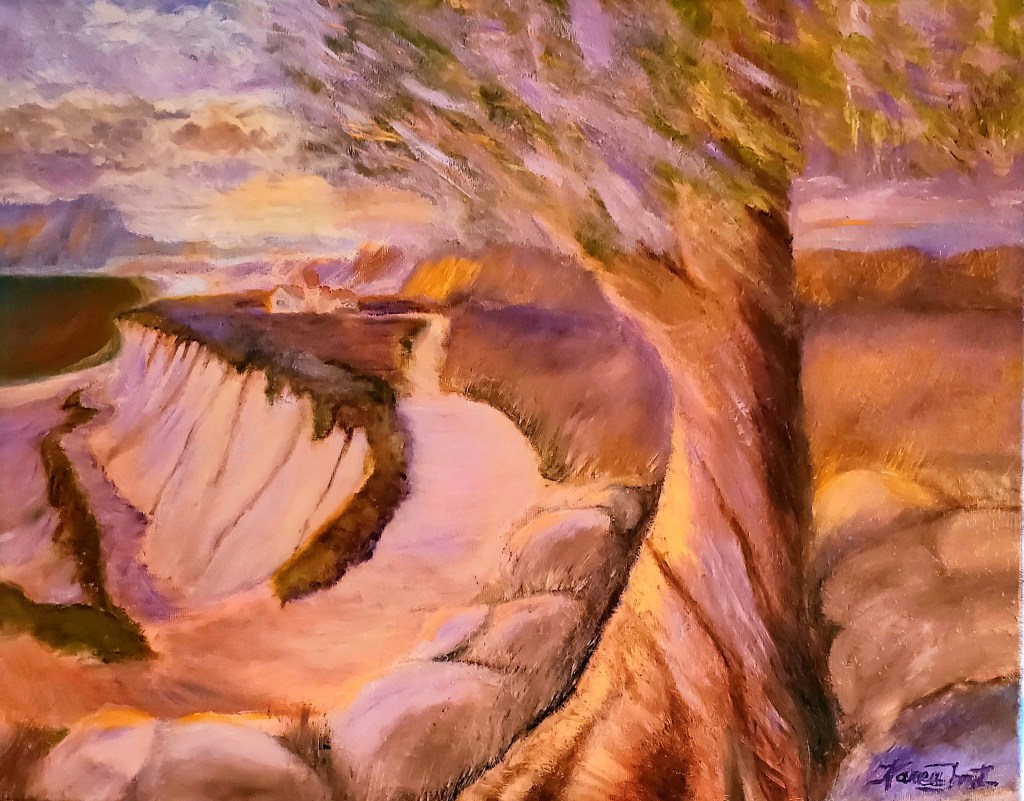
Beachpath Moonrise. Oil on canvas – Karen Trout
 Karen Trout